Opening
I’m pulling together the books I read this past Q1 in one place. I reached for whatever was around: fiction, classics, biography, self-help, startup, leadership, sport. Some I wrote long reviews of, others I covered in dedicated posts, so the lengths vary. I’m just logging them in no particular order.
Stoner, by John Williams
I actually read this one back in November but never wrote about it anywhere, so I’m putting it here. It was the first novel-as-novel I’d felt in a long time. Maybe the fact that it isn’t dramatic is exactly why it lands with so many people. Following one man’s life secondhand, I came away feeling like I’d lived through the whole sweep of frustration and constriction we all carry, and the everyday determination of someone who still gave each day his best. (The afterglow stuck with me long enough that I subscribed to Millie’s Library for a month just to read critic Lee Dong-jin’s review.) There’s a reason so many readers call it the book of their life.
It’s a quiet novel, walking through a life’s events in sequence, but a few “villains” do show up. Not dramatic ones, just the kind of people who keep needling and obstructing him in an otherwise unremarkable life. What fascinated me was how closely those villains resemble the ones in our own lives. Nobody who’s done you wrong enough to deserve being killed off, just the irritating people you meet along the way, captured with uncanny precision.
And like most of us, Stoner never once defeats them. I’m still recommending what sounds like a soul-crushing novel because I’ve rarely encountered one that renders a single life so close to the skin, and I want you to feel the afterglow of walking with him from beginning to end.
I’ll defer the formal introduction to critic Lee Dong-jin’s recommendation video.
Don’t try to win the war that’s your whole life. Try to win the daily battles. Stoner was that kind of person too.
Lee Dong-jin (translated by author)
The Obstacle Is the Way, by Ryan Holiday
I picked this self-help book back up after a long break, planning to read it together with George and Ellie. Truth is, it’s not a great book. The one redeeming function: that signature self-help lightness was unbearable enough that I went and read Meditations, the Stoic classic the book keeps quoting.
The full review is here.
Meditations, by Marcus Aurelius
I read this in small daily doses, almost the way you’d read scripture. If I May Be Wrong (which I love) is essay-shaped, this one sits closer to scripture. Reading it while remembering that Marcus was talking to himself makes it surprisingly compelling.
I’d wanted to read this classic for ages, and The Obstacle Is the Way finally pushed me to it. The passages where he scolds the part of himself that wants to stay safe under the covers (using these almost dogmatic lines) are the highlight. Whenever life gets hard down the road, I think I’ll find comfort in the lines I underlined in his diary. I read with a pen, sometimes switched to audio, and I plan to gather the passages I marked into a separate note.
“Everything depends on how you take it” means that the character and impact of any external thing or circumstance (anything value-neutral, with no inherent connection to happiness or to good and evil) depends not on the thing itself but solely on how a person receives it. (translated by author)
When daylight comes and you don’t want to leave your bed, tell yourself: “I’m getting up to do the work of a human being. I was born for this work, came into the world for it, and now I’m complaining and balking? I wasn’t born to lie under blankets enjoying warm comfort.” (translated by author)
Source Code: My Beginnings, by Bill Gates
I bought this the moment it came out last year and only got around to it almost a year later. I’d absorbed the Microsoft founding story through other media (Pirates of Silicon Valley, the 1999 docudrama, and so on), but reading it in his own words gave me a much more granular account of everything up to the founding than the version I’d vaguely held in my head.
This is part one of his life. The main material is his childhood, before Microsoft. Part two will probably be the rise of the Microsoft empire, part three the post-retirement years. It has a different feel from Walter Isaacson’s Elon Musk and Steve Jobs, but peering into his unusual childhood was its own kind of fun.
(Of course his scandal broke right as I was reading this, which made writing about it feel awkward. Still, I read it, so a quick note.)
How long do you have to focus and grind, day after day, just to do a little better than yesterday, for how many years, before you reach the top? (translated by author)
Bird That Drinks Blood (first half), by Lee Yeongdo
I cried while reading Bird That Drinks Tears during a high school class. I think it was sophomore year, and the scene I read at the very end is still with me. I kept meaning to read Bird That Drinks Blood and never quite got there until the 20th-anniversary edition came out (honestly I wanted the Tears edition), at which point I bought the whole set and started chipping away at it last year, picking it up in pockets through Q1.
I still have a few volumes left, but it has far more characters and factions than Tears did. If Tears is The Lord of the Rings (specifically the Fellowship), Blood is closer to A Song of Ice and Fire (Game of Thrones). (In the ensemble-drama sense.)
The variety of character charm and the world-building solidified across both books reach a kind of essence here, and there are scenes that genuinely make you marvel. There are still sentences that hit you in the gut, and a few that feel a little juvenile, maybe because the book has aged. (Or I have.) I’ll still finish it and write up the rest in next quarter’s post.
The one who falls from the horse is the one who rode it. The defeated general is the one who went to war. The drowned Lekon is the one who went into the water…. Every loser is someone who kept winning right up to the moment of defeat. Life is a long journey toward losing. Life isn’t to be spent on winning; it’s to be spent on losing. (translated by author)
Battlegrounds, Onto a New Front: The Second Krafton Way, by Lee Gi-mun
My first impression after reading the original Krafton Way was: “they got really lucky with how PUBG came to be.” How Bluehole (Krafton’s earlier name) was founded, the trial and error that led them all the way to PUBG: the story itself was riveting, but I felt I had no real lesson to take from it.
This second book was different. They’d hit a global home run with PUBG, and now the book is full of the messy, real work of turning that one-time success into a sustainable organization, company, and service. Unlike the first book, much of this one left a deep impression on me.
They had to walk through a grueling, drawn-out process to turn a globally successful service into something that lasts, not a one-off jackpot. Reading along, I felt the strain with them, and at the same time I found myself envious of a team this aligned, pouring their lives into the work to push the service forward.
The dialogues at the center, between Chang Byung-gyu and Kim Chang-han, are sharp to the point of “is this even okay?” Watching leaders of a company at this level keep clashing this hard, studying the org, trying to talk to their people (one-sided as it sometimes is), I kept asking myself: did I ever put that much effort into the orgs I was part of? It triggered a lot of reflection.
I’d guess this book was Chang Byung-gyu’s idea. It’s worth recommending because beyond the behind-the-scenes of building and shipping PUBG, you get a lot of the work of building org culture (and the difficulty of it), and the agonizing behind various business calls, conveyed without much editing.
I hope Krafton doesn’t end up as a PUBG one-hit wonder, and that they keep growing through diverse IP and game titles. (Since Krafton holds the Bird That Drinks Tears media IP, as I mentioned, I’m hoping for a Korean Witcher.)
Within PUBG, no one had seen Kim Chang-han stripped down to the mad-dog persona. Kim Chang-han didn’t carry the substance of his negotiations with Bluehole’s leadership, or the friction they caused, into PUBG. What he looked like outside PUBG, no one inside knew. (translated by author)
A person with ownership over something owns the delivery of the message too. Let’s not say “I sent it; they didn’t receive it.” If we start passing responsibility around like that, we don’t get to an answer. Before debating whether the means are efficient, the person with ownership, whether of communication or of work, has to take responsibility until the message lands. (translated by author)
Korean developers got into development as a job. Passionate people are the ones who should be diving in, and I’m not sure how many of those we have in Korea. (translated by author)
When the entire dev team stops developing and starts playing the game they made, that’s the launch date. (translated by author)
Lost and Founder, by Rand Fishkin
Some VC trashed it on Threads as “garbage” and mocked the author’s “weak” mental state for wallowing in self-pity, which made me want to read it immediately. The author founded the SEO startup Moz, and the book covers his very naive early days in business, his regret about not exiting after VC funding turned things around, and a critique of the growth-hacking and J-curve gospel preached in the Valley (and the broader startup scene). It tells the unedited version of the story you don’t get from Facebook or the small handful of breakout success stories.
These days, thanks to AI, there’s a growing belief that you don’t necessarily need VC funding, and bootstrapping is part of the conversation. But back when I started in the early 2010s, every startup’s top mission was to take VC money and become a unicorn. Mine was no exception, even though not every business can be a unicorn.
There are companies that use VC funding to run on losses while chasing explosive growth, and there are companies that build cash flow in a niche market and grow steadily. If you’re thinking about a startup, this book is worth reading at least once. It’ll help you weigh what you actually want, what kind of business growth fits you. His mental anguish, and his stage-by-stage regrets and advice, meant a lot to me.
If I’d read this ten years ago, would I still be running my own business today?
The moment you believe you can hide the truth, the brake that stops you from doing bad things is broken. (translated by author)
A founder’s traits get embedded in the organization almost permanently, while employees’ traits change over time. Part of the reason is that founders stay much longer and exert influence for much longer. But even when the team turns over, what remains is an indelible imprint left by the founder’s biases, the business structures they built, the way they hired, the way they delegated, how they allocated resources, their passions, and their blind spots. I see this pattern repeat in companies of every size, industry, and configuration. The founder (and CEO) governs not just the personality and culture of the org, but also the foundational strengths and weaknesses that shape the organization’s trajectory for years or decades. (translated by author)
The Score Takes Care of Itself, by Bill Walsh
This one is a pretty famous leadership book in the US. So many people recommended it that I read it in the original English, carefully underlining as I went, with an AI agent making the process much easier.
The full review lives in this post.
Formula One, by Joshua Robinson and Jonathan Clegg
This is one of the books I bought and finished fastest. Inside you get the F1 industry titans I’d only heard about (Enzo Ferrari, Bernie Ecclestone), the championship drivers from Niki Lauda, Ayrton Senna, Michael Schumacher, through Lewis Hamilton and Max Verstappen, plus the major chapters of team history and the stories behind them. Built from years of reporting by Wall Street Journal writers, the book reads as both a tribute to F1’s past and a mix of affection and worry about today’s American-market-centric era.
I came into F1 through Netflix’s Drive to Survive season 1, watched on and off for a while, and only started catching every race last year. The book retraced the older F1 history for me and unpacked even the famous events I already knew with great backstage detail. Last year I followed every race closely and traded paddock news and driver memes with Ellie, so this year’s new Drive to Survive season felt thin to me. (Documentaries always aim at total newcomers.) That disappointment is part of why I wrote a separate post on F1 leadership.
Then, after the first three races this year, the war in Iran caused two April races to be cancelled. That doubled the disappointment. This book filled the gap. After Liberty Media bought the sport and the Netflix doc dropped, F1 entered a completely new era. A race is, at heart, a game to decide first place. But racing has become a status sport, and the fact that drama from mid-pack and back-of-the-grid teams gets consumed alongside the title fight is genuinely interesting. As the book points out, there are now people who call themselves F1 fans without watching a single race. (I was one of them up to two years ago.)
If you’re curious about F1, watch the Netflix doc; if you came in through the doc and want to know F1’s older history, this book is exactly right. The Miami Grand Prix is two weeks away, so go buy it now and read it.
In that sense, F1 had become a kind of “post-sport.” We’re now in a world where you can call yourself a die-hard Formula 1 fan without watching a single race. They’re full-on supporters who pour their lives, attachment, and money into F1. (translated by author)
Principles, by Ray Dalio
This is the famous book by investor Ray Dalio. I read about 60% and put it down. Part 1 was a fascinating secondhand tour of his life, but parts 2 and 3 are quite literally a list of “principles,” which threw me a bit.
These days a self-help book written this way would probably get torched. But it came out seven or eight years ago when plenty of people around me recommended and raved about it, so I’d had it for a long time, sitting like a homework assignment. Reading it now, the rapid-fire list of principles in parts 2 and 3 felt off. I don’t lean toward this kind of structure, and I’m allergic to the self-help genre to begin with. Setting aside the fact that he’s a successful investor, I’m not sure the book deserves the praise it gets.
That said, his principles aren’t unreasonable. They’re decent advice. The problem is that for any of these messages to actually land in my own life, they need to leave an impression, and they didn’t.
The book is very thick. If you’re just curious about who Ray Dalio is, part 1 alone is enough; his story carries it. Imagine if they’d split it into three volumes and sold part 1 separately. Some readers call it the book of their life, so trying it once and forming my own opinion was at least worth something.
What you do after failing matters most. Successful people grow by leaning into their strengths and shoring up their weaknesses; people who fail can’t bring themselves to do that. (translated by author)
Closing
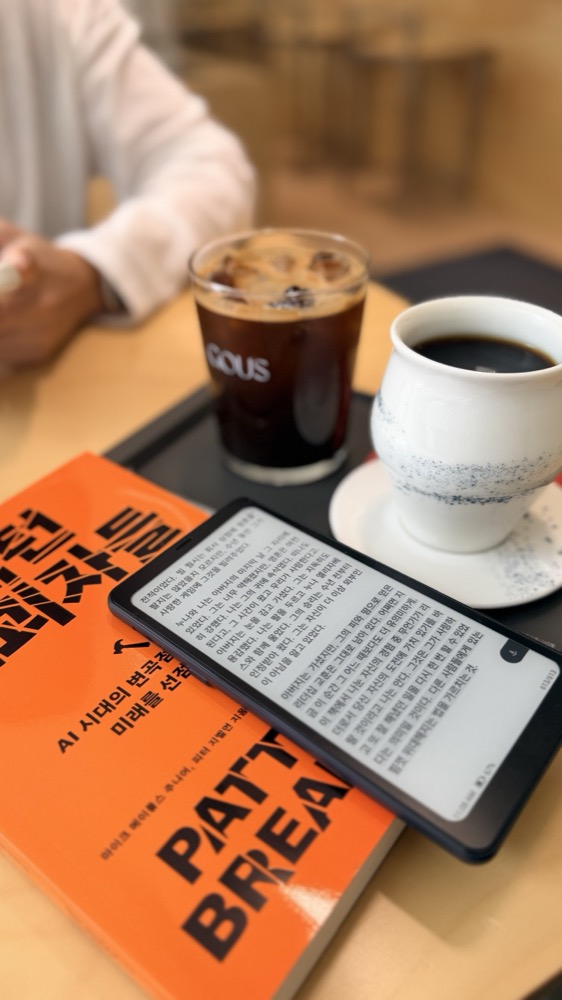
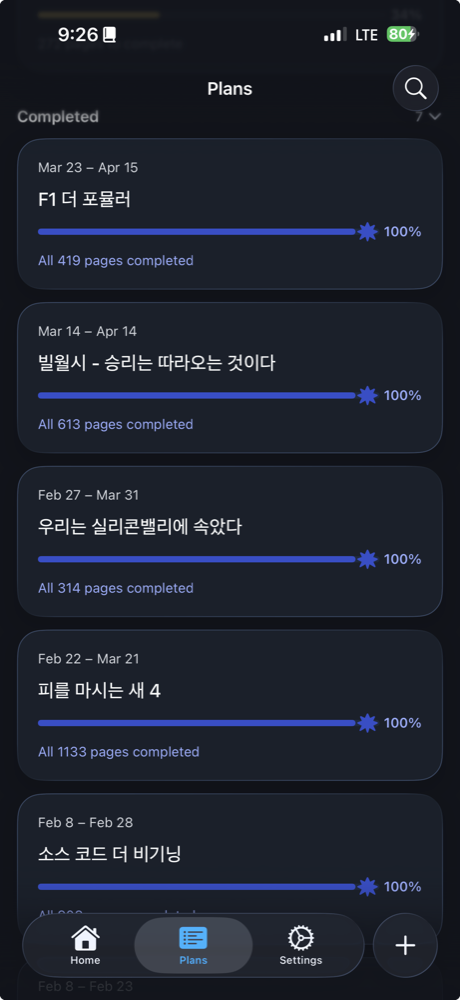
For the actual reading I mostly used Todait, which I’m building (again) right now. Even with three books in flight, the per-book pacing balances itself, so I worked through them one chunk at a time. Reading multiple books at once turned out to be more chaotic than expected. If work gets busy and I miss a few days, the backlog stacks up that much, and I’m thinking I should cap it at two books in flight.
I started reading in earnest in February. Roughly one book per week (and we’re already in mid-April). Reading a lot is good, but I want to keep stacking reviews and leave at least rough notes for thinking. Some of these books I read a while ago, and not having taken notes at the time made it harder to write from memory.
Half were physical books, and for the other half I bought the Onyx Palma 2 (a phone-sized e-reader) so I can read anywhere. Lately I leave my smartphone outside the bedroom and bring only the e-reader and whichever book I’m in. It’s helped with sleep and with reading both.
I still have plenty of unread books stacked up. To keep the reading habit going, I’m leaving a quarterly note. See you in the next quarter.
댓글
댓글을 불러오는 중...
댓글 남기기