Opening
Half-baked products die. AI has driven the cost of building down to almost nothing, which means anyone can ship fast, which means what you build is now everything. Product Market Fit has to mean a product that sells without marketing. Is that the level our MVP is at?
Truth is, when I scroll Threads I keep seeing solo developers drowning in marketing. There’s an argument going around that “AI handles the build, so marketing is everything,” and I sympathize to a point. But lumping it all under “marketing” is a cop-out. The word marketing covers content, performance, sales, and yes, the customer development I’m writing about here.
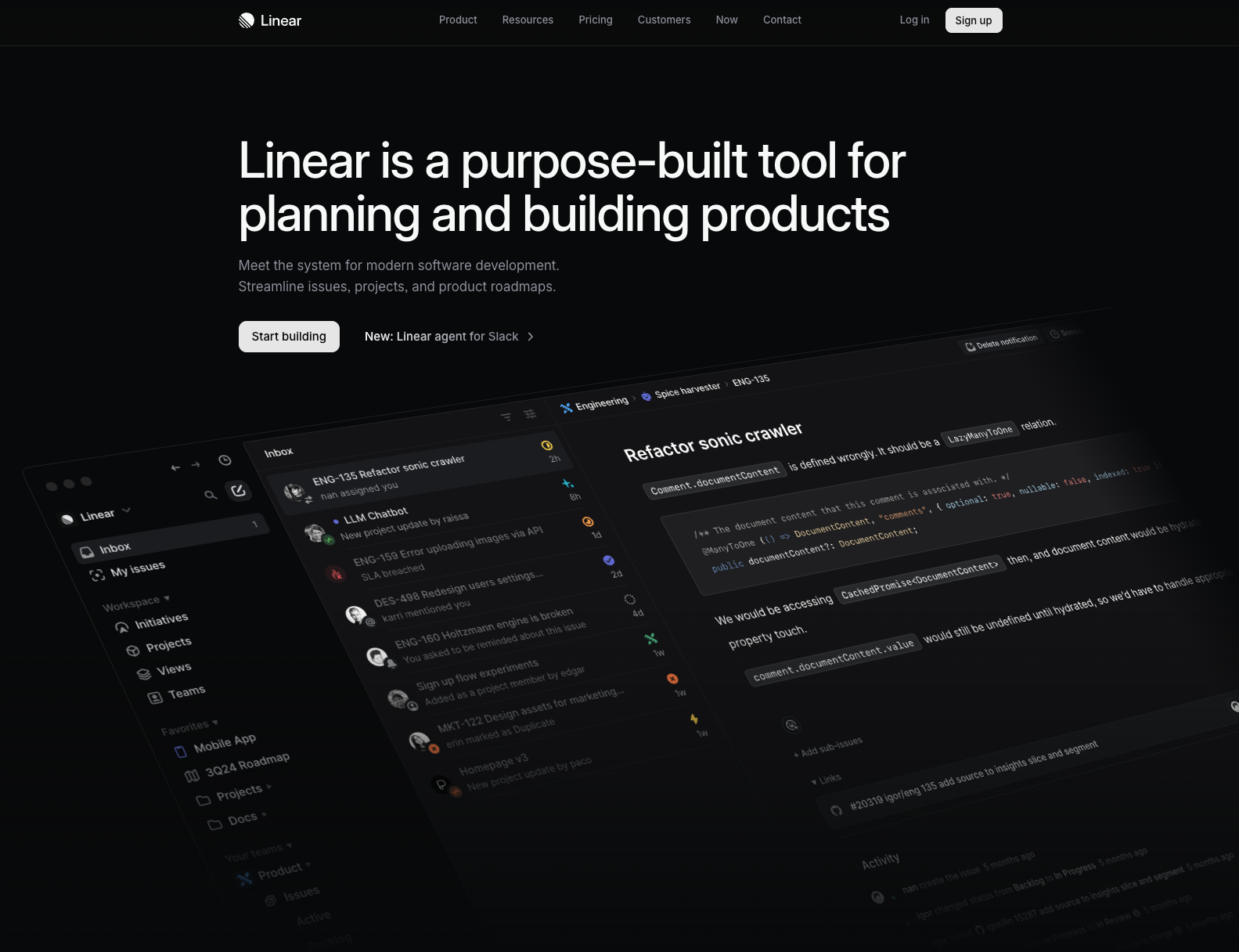
I learned a lot from studying Linear while I was deep in customer development and MVP work. The lessons are practical enough for early SaaS that I wanted to write them down. The interesting thing is how much of what I’m reading now in Solving Product, plus Linear founder Tuomas Artman’s writing, kept overlapping.
The modern MVP is a different animal
“Building something valuable is no longer about validating a novel idea as fast as possible. Instead, the modern MVP exercise is about building a version of an idea that is different from and better than what exists today.”
— Tuomas Artman, Linear
Linear’s founder is direct about it. The MVP is no longer “validating an idea fast and cheap.”
The MVP that Eric Ries defined in The Lean Startup in 2011 was “the version that gets you the most validated learning for the least effort.” Back then Airbnb had to validate “would anyone sleep at a stranger’s house?” and Lyft had to test “does ride-sharing actually work?” The ideas themselves were brand-new categories.
What about now? Most categories are already saturated. Someone has built it. Someone has built it better. So a new product survives by proving it’s better than what’s already out there, not by validating that the idea exists.
The gap is enormous. In a validation phase, a rough prototype is fine. When you’re competing (and users already know the alternatives), your product has to be substantially better.
“Just ship fast” doesn’t cut it anymore. As Linear learned, today’s MVP has to be a competitive product, sharpened over time. And to get there, you have to be clear from day one about what you’re actually building.
The power of narrowing the target
Linear’s strategy was simple.
The company’s vision was to “become the standard for how software is built.” That’s enormous ambition. But if Linear had targeted every developer and every team at the MVP stage, they would have failed. Resources would have been spread thin and feedback would have been all over the place.
So Linear narrowed the target to an extreme. “Individual Contributors at small startups.” More specifically: “engineers at small teams who were struggling with issue tracking.”
And they focused on three things:
- Fast: local storage, no page reloads, works offline
- Modern: keyboard shortcuts, command menu, context menus
- Multiplayer: real-time sync, teammate presence
The interesting part is that Linear’s founders were exactly the ideal customer. Their strategy was “let’s build it for ourselves.”
I had a similar struggle when I first started a startup. I genuinely did design the early product around a target customer, and we hit decent enough metrics to raise a round. But after the funding came in, growth flatlined, and instead of staying loyal to that core customer, I kept tacking on features that users requested in order to expand the surface. I’d pull all-nighters on a feature and then sigh through the morning. The metrics never moved. The customers didn’t actually want it.
Looking back, the first thing I should have done was define “who are the customers we genuinely love?”
There’s a catch worth flagging here. Linear’s “ICs at small startups” wasn’t just a narrow slice. It was a group with strong motivation and high expectations. Translated: people who knew they had a problem and were already looking for a solution.
That’s the central lesson in Solving Product too. Find the High-Expectation Customer. The customer for whom your product feels less like an option and more like a lifeline. The kind of customer who, like a patient who can’t function without a specific medication, feels “if this disappears, I have a real problem.”
Feedback loops and how to use a waitlist
Linear’s second lesson was how to use a waitlist.
A lot of startups treat the waitlist as a “marketing channel” or a way to inflate the user count. Linear thought differently. The waitlist was the whetstone for the product.
Concretely, Linear:
-
Asked specific questions at signup:
- What’s the size of your company?
- What’s your role?
- What are you using right now?
- What’s frustrating about your current tool?
-
Invited the people who could actually give feedback first. Linear only integrated with GitHub, so they started with founders of small startups who used GitHub.
-
Listened to the feedback and iterated. They kept polishing the existing features until “new feature requests” tapered off.
-
Once things stabilized, they invited the next segment.
Why does this matter? Because feedback from the wrong customer breaks your product.
Solving Product warns about this directly. “The average of all feedback leads to a terrible product.” That’s not a value judgment, it’s math. Try to converge a hundred different needs and you end up with the average product. The bland one.
Go the other way and listen only to a tiny, eccentric feedback group? Then you build “a product for very strange people.” That’s why balance matters.
The most effective approach ends up being:
- Selecting early customers with clear criteria (is our target unambiguous?)
- Going deep with that group (a lot of people vs. a few you understand intimately)
- Acting only on patterns in the feedback (recurring issues, not one-off requests)
Defining and segmenting customers properly is genuinely critical. Like a sculptor chipping away the unnecessary marble to reveal what’s essential, even inside a segment you have to keep what’s core and ruthlessly remove the rest.
How to find high-expectation customers
So who counts as a “high-expectation customer”?
Tuomas at Linear asked customers directly:
- “What would happen if Linear didn’t exist?”
- “What’s the biggest help Linear gives you?”
- “How could it get better?”
The “I’d genuinely miss it” customers were the early group.
Flip that around: a customer who used the product because it “seemed convenient” can be dropped from the waitlist. They didn’t really commit, and they’ll bolt the moment a better alternative shows up. At the PMF stage you need customers who love the product. Not customers who like it.
The obvious question lands here: “If we don’t even have a product yet, how do we find customers like that ahead of time?”
The trick is to start from the opportunity, not the product. The product is, in the end, a solution to a customer’s problem or desire. Which means even before the product exists, the people who feel that problem urgently are already out there. Find them first.
The flow looks like this. Define the opportunity you’re trying to solve. Go find the customers who are actually living through it. Talk to them, understand their context. Then put the MVP in their hands, and that’s the moment you find out whether they’re really high-expectation customers. Customer comes before product, and opportunity comes before customer.
Solving Product spells it out further. A high-expectation customer is:
- Someone who recognizes your product’s core advantage
- Someone with strong motivation to solve their own problem
- Someone with high expectations of the product
Put plainly, “someone for whom this isn’t one of several solutions, it’s their only hope.”
My own experience matched this. The customers who actually paid and stuck around in the early days were almost all the ones saying “if this disappears, I have a real problem.” The ones who used it because it “seemed convenient” left the moment a better option showed up.
So the early playbook is:
- Find five high-expectation customers
- Make those five genuinely happy
- Ignore what the other hundred want (early on, only)
That sounds harsh, but it’s the only way to raise the odds of success.
I once worked at a company that mostly did B2B SaaS. The CEO was selling to “potential customers,” and “potential customers” said they’d buy if “this one feature” existed. We’d burn three weeks of team time building a brand-new feature for a $10/month enterprise customer. At the time I thought that was the right call. MRR impact: 0%. The feature only ever served that one company, and the next sales opportunity never came.
Watching B2B SaaS companies in Korea, the pattern I kept seeing was startups that started out with conviction in their product, then slowly turned into outsourcing shops after raising a round. Chasing (potential) customer needs cost them their identity. Yes, the domestic market is small and the core customer pool is genuinely tiny, but the path to success is to refuse the easy substitutes and push head-on toward satisfying only the customers who actually love your product.
Solving Product hammers the same point. A “potential customer” is not a customer. The customer is the person paying out of their own pocket and using your product. Worth asking sometimes whether we’re being yanked around by too many “potential customer” voices. (That includes friends and family if they’re not the target.)
What the modern MVP boils down to
Pulling Linear’s case together with Solving Product’s lessons, here’s what the modern MVP looks like:
- Building a competitive product, not validating an idea. Sharpening, not just shipping fast.
- Narrowing the target to an extreme. Giving up on “for everyone.”
- Managing the feedback loop strategically. Finding patterns, not collecting opinions.
- Centering high-expectation customers. A few who love it beats many who like it.
- Built to a level that sells without marketing. PMF is the product as evidence, not the campaign.
The final criterion is the cleanest. If your product genuinely has PMF, word of mouth happens without marketing. The state where high-expectation customers can’t stop telling people around them.
The AI era, and the question that’s left
The faster development gets, the more what you build matters. Thanks to AI, anyone with a decent idea can ship quickly. Which means the competitive edge is no longer execution speed. It’s a sharper target, deeper customer understanding, and the courage to delete fifty percent.
Closing
Honestly, the word “MVP” used to frustrate me. The “minimum” part. But looking back at the last few years, that “minimum” was actually the most aggressive choice you could make.
Following Linear’s story, this is what hit me: you have to build a product that sells without marketing.
How is that even possible? The answer is in everything I covered above.
First, abandon the fantasy of “a product for everyone.” Instead, find high-expectation customers through extremely narrow targeting. Not trying to clothe everyone, but tailoring a bespoke suit for one person. Picture three to five specific people, get clear on what they actually need. The moment you change the question from “for everyone” to “for this person,” your product gets a direction.
The next part is courage. When the feedback floods in, you have to choose. Tune out family and friends. Listen only to actual customers. And only act when the same problem shows up three times or more. One person’s request is unique, but a pattern is universal. Holding direction matters more than absorbing every piece of feedback.
The core is this. Find the customers who’d be genuinely disappointed to lose your product, and pour everything into satisfying them perfectly. Other customers come later. In the early days, all your energy goes to those five high-expectation customers. When they say “I’d really miss it,” you’ve found PMF.
The discipline through all of this is choice and focus. You have to be able to ask “what gets cut if we removed it and the core value still lands?” and then delete fifty percent of the features. Like chipping marble away to reveal the statue, the essence emerges as the unnecessary parts get removed. Linear probably wanted to pack in tons of features at first. They removed the ones they didn’t need. That became the competitive edge.
The faster AI makes development, the more critical this kind of choice and focus becomes. The technical difficulty is already solved.
In an era where AI is making development cheap, only one thing is left.
“Who are you building this product for?”
It isn’t marketing. It isn’t scale. What we have to wrestle with is who we’re really building this for.
The work in front of you is clear:
| Core principle | How to do it |
|---|---|
| Built to sell without marketing | Sharpen the product into its own evidence |
| Extremely narrow targeting | Define three to five specific customers |
| High-expectation-customer focus | Make only the customers who love it perfectly happy |
| Strategic feedback | Act only on recurring patterns |
| Courage to delete fifty percent | If it doesn’t carry the core value, cut it |
“The smallest team with the strongest clarity will always beat the largest team with the most confusion.”
Books worth reading alongside
- Solving Product (Ravi Mehta, translated by Lee Yong-bin). A concrete unpack of high-expectation customers and opportunity-driven thinking. Half of this post came from here.
- Continuous Discovery Habits (Teresa Torres). A framework for turning ongoing customer conversations into a habit. Read it if you want to systematize the feedback loop.
References
- Rethinking the Startup MVP: Building a Competitive Product - Linear
- Solving Product - Ravi Mehta, translated by Lee Yong-bin
- Lean Startup - customer questions
- Continuous Discovery Habits notes
- Ellie’s reading notes
Thanks to Ellie. This piece was inspired by the reading notes Ellie prepared for our Solving Product study group.

댓글
댓글을 불러오는 중...
댓글 남기기
Legacy comments (Giscus)