Right after wrapping the first release of Scrumble, Tony, Ellie, and George sat down to talk honestly about everything from how they joined the project to what happened behind the scenes at the workshop. If you want the full arc of the project itself, that’s covered in the Scrumble Project Retrospective (June–August 2025). This post is the interview record: each person’s view, in their own voice.
Q1. How did you join, and what were you hoping for?
Tony
I’d been away from hands-on engineering work for a long time, so I needed a project that would relight the fire. And ideally, something I’d actually use every day and could keep improving over the long haul.
The idea came from the daily meeting notes I used to keep at my old company. Check in, check out, share what you’re working on. When you come into the office every day and see each other for hours, even a quick check-in becomes the lubricant for team communication. I wanted to build something that contributed to teamwork through daily check-outs and work updates.
My goal was to develop the BE/FE stack end to end and get my chops back, while also actually shipping a complete project.
Ellie
Like Tony, I’d been away from design work for a long stretch and was thinking, “I should be doing something…” The timing happened to line up, and that’s how I ended up working on Scrumble.
Personally, my own experience with daily meetings had been pretty positive. I’m someone who values “soft touch.” That said, I’d never seriously thought hard about how much that process actually contributes to work efficiency or output, from a manager’s seat. So when Tony told me he was feeling that exact gap, I got really curious: “What if we dig into users with this kind of need and shape the product around that direction?”
As always… we started with the noble intention of “let’s focus on the MVP,” and somehow drifted into thinking about B2B sales (…) before we knew it. (We were literally just starting initial product planning.) Thankfully, we caught ourselves and reset our expectations to match the original intent! Hehe.
At some point on this service’s journey, I think we’ll hit a fork between being a messenger and being a social network. It’s a sensitive topic these days, so I’m being careful, but when that moment comes I hope we make a wise, confident call. Personally, I’m hoping we can land on a balanced kind of communication, one that holds onto the warmth of social connection without all the unavoidable stress that comes with it. Ultimately, it’s a small wish, or maybe a big expectation, that we can make it all feel seamless. Hehe.
George
I’d been studying through bootcamps and study groups, but I always felt there was a big gap between that and actual industry work. In the middle of that, I joined a company.
It was different from the bootcamp days, but it still wasn’t quite what I’d pictured as real work. I spent a little over a year there and felt like I wasn’t really gaining anything. (My premise was wrong from the start. Building actual experience is what makes future job changes possible.) The pattern of just reading the room at work, killing time when nothing was going on… that’s not the life I want. I want to actually know how to do this and do it well, so when I was given a chance to join the team, I took it.
I want to finally start building real on-the-job know-how and actual communication skills with teammates.
Q2. What was the hardest moment along the way?
Tony
The hardest stretches were the wrap-up phase and the time I spent on the tiptap editor. Toward the end, we had a design issue that meant migrating every API, and along with that, a mountain of unfinished release tasks piled up. I just couldn’t get any momentum and kept pushing the project back.
The Jeju workation at the end of July helped me reset, but my biggest feeling is: I wish I’d pulled myself together a little sooner.
And tiptap. I tried it early on, decided the feature surface was overkill, and rolled it back. That’s the moment I most want to undo. Later, there were way more entangled features and way more accumulated data, so adding it back was much harder. I burned a ton of time on it and never finished. If I’d just done it from the start, things would’ve moved faster. That’s the moment that sticks with me, haha.
Ellie
I’d mostly done mobile design before, so when I tried to work on web views… the canvas felt like open ocean. That’s where I lost a lot of time. And I let my planning ideas run wild, daydreaming about a rosy future without permission, so I wasted a lot of the time I should’ve spent on the actual core work. My heart got way ahead of me (sob), and things got pretty tangled up. Hehe!
A moment I’d take back? Pushing component-ization way too aggressively before the design was even fixed (which ended with me ripping it all out and starting over). Charging in with color choices first. I should have set the weight aside and focused on the truly core features and value, but I wasn’t confident there, so I buried myself in interaction details instead. Skipping hand sketches because they felt like a waste of time and just sitting in front of the monitor flailing. Where do I even start? (sob sob) If I could undo all of it now… could I actually do it well? Hehehehe.
The root of all of this is probably some unholy mix of perfectionism + arrogance + laziness + bottling it all up. Lesson I keep relearning: when you’re setting direction, discuss fast, focus fast, execute fast.
George
At my company, when a particular task ends and they don’t give me the next one (because there’s nothing to do), I sit there killing time. That stretch is brutal. Scrumble was the opposite. It wasn’t that there was nothing to do, it was that I had so much to do, in my own way, that I didn’t know how to start chipping away at it. Too much on the plate. That was its own kind of hard.
Like Tony said, you just have to put in the raw hours and start with the small things, the things you actually can do. But because I had so much and kept putting it off, it snowballed and I’d end up just sitting there blank for long stretches.
Because of that, there were periods during the project where I’d hit sudden, deep exhaustion. I haven’t fully fixed the habit yet, but if I could go back to those moments now, I think I’d just start with the small things instead of overthinking it.
Q3. Tony, how did it feel to work as an engineer again instead of a manager?
Tony
I wrote about this in my retrospective too. It was genuinely happy and genuinely painful. And one thing became really clear: no matter how much AI boosts productivity, my mental model and memory have hard limits. To finish a thing all the way down to the last detail, I can only really work within the scope I can hold in my own head.
Without Claude, this would’ve taken much longer and full-stack development would’ve been even harder. But there are still a lot of pieces I have to work through myself.
Even while doing engineering work, the manager skills helped me sometimes (using AI well, making decisions). But the things I was actually good at as a manager (communication, prioritization) got dropped while I was head-down coding. That cost was real. This project was about going back to engineer Tony, not team-manager Tony, and from that angle I’d say it was a success.
Q4. What’s the next goal you want to focus on, Tony?
Tony
For solopreneurs and small teams, what really matters isn’t which tech stack you use. It’s whether you actually build a product customers want. I’ve spent a long time on the product-management and team-management side, so now I think it’s time to run with growth as the focus.
I’ve done plenty of “talking” through this project. There’s a recent talk I watched that said the whole point of a product leader, the final goal, is leading the team to victory. I shared this at the workshop too: I want to give everything I have to getting those wins.
Q5. Ellie, how did it feel to be back in product-designer mode?
Ellie
I felt my limits, hard. First, I had to admit, objectively, that I’d gotten pretty lazy. This was actually my first time using AI seriously. Once you taste what AI can do, you really do get lazy.
I used to sketch by hand, thinking through technical constraints and development direction in my head, organizing UI and UX together… but this time I worked far more with my eyes than my hands. That said, for the kind of documentation work where the time investment usually outweighs the impact, AI made things much smoother. I saved a lot of time. The proudest moment was when I clearly mapped out the edge-case users for the service.
It’s a project that got me back into work mode after a long time, so just that part feels good. But I only managed to handle the open-ocean (…) of the web view, so I’m not super satisfied with what I made. Honestly, I want to rip it all out and start over. The desire is there, anyway, hehe.
Q6. Any conflicts with Tony you remember?
Ellie
Truth is, I can’t even remember what we were fighting about that hard anymore. (Looking away.) When you collaborate, it’s all just differences in perspective, and everyone’s saying something reasonable, and then you start going “no you’re the right one, no I’m the right one,” and voices get raised. That’s just how it goes, right? Hahaha! And thankfully, somehow, Tony and I always seem to find our way through and let it out, for better or worse. Hahaha!
I think conflict and raised voices in a discussion are part of the process of reaching a result, so I expect we’ll keep fighting plenty. -But the emotional toll inside that process, I can’t ignore that either. (And these days, the emotional toll turns into a physical one too… apparently…?) So going forward, I think we need to set the focus of a discussion clearly. Not just the topic, but the limits (time, scope, feature boundaries) agreed on in advance. That should cut down a lot of the emotional drain.
Q7. George, what did you get out of investing your evenings and weekends?
George
I didn’t have a clear technical target from the start. My goal was more about engaging with the work more actively than I had during my previous baseball-app side project and study groups, and to actually try to communicate well.
At first I was overdoing the communication a bit, and as the project went on I dialed it back. But I came to realize that everyday chat isn’t the whole of communication. The real thing is sharing, on a work level, where you and the other person are in your understanding and what you’re each working on. I want to apply that actively in the next project.
As the project went on, I half-joked that I wanted to become an “API factory boss.” But I still find it hard to write design documents and requirements documents, so I’m going to keep writing them, getting feedback, and revising.
Q8. Going forward, how do you want to contribute as a teammate?
George
For now I’m part-time and handling small pieces. But even those small pieces are tough to do alone without Tony’s help. Full-time is out of the question right now. I want to become a teammate that Ellie and Tony can hand the parts I currently work on to without worrying.
Q9. The first-release workshop: what was the best part?
George
It was the first workshop I’d ever attended in my life. Both of you put so much into preparing it, and I wanted to match that effort and engage properly.
I really listened to Ellie and Tony’s presentations, and I got a lot from the materials too. So that’s how you give a presentation, that’s how you build the deck. I’d been worrying out loud beforehand (I don’t know how to do this, building presentation materials is hard), but when I finished, you both told me you’d actually been worried too and thanked me for delivering. That meant a lot.
Outside the workshop itself, the Seoul itinerary (the full course!) and being able to stay overnight in Seoul were so satisfying. So grateful. Honestly, the whole thing made me think: so this is what a startup feels like?
Ellie
For me, the main target audience for this first-release workshop was actually George. So I admit I put a little extra into the venue and the activities! If the workshop had just been about sharing deliverables, we could’ve done it remotely without losing much. But I wanted the atmosphere to match the purpose of our Scrumble service, and I think we landed it well at this event.
I poured myself into the presentation deck. That’s the magic of a workshop, the something that makes you look forward to the next one. Smooooth operator~~~~~~
Tony
I sometimes come across as the “I do fine on my own” type, but the truth is I really love working as a team. I love people. So even though this was a much smaller team than what I’m used to, it was a blast. I wanted to show George, who hasn’t worked at an IT startup before, what that culture looks like, and I also wanted to send the message that even though we work remotely, we’re working as one team. Each person’s presentation was great, and I think we genuinely listened to each other. This time it was a workshop celebrating wrapping the project, but next time I hope we can throw a real results-celebration party. The workshop did a lot to motivate everyone.
Q10. What’s the next goal you want to hit with Scrumble?
Ellie
On the design side, it’s the mobile view and branding. Because the design was patched together, I find myself side-eyeing my own work, hehe. I’m still figuring out exactly how to approach it, but I really want to fix it.
At the workshop I shared “Insights on the G-type user, UX improvement points,” and I want to keep stacking small UX optimizations like that. I believe small details add up to a big difference in experience over time.
And (small confession here) when I documented and proudly shared what I called an “edge case” a while back, the more time passes the more I realize that “edge case” might just be… me, hehehe. So in that sense, Tony was my first customer at the start, but now I think I’m also a target user. Ultimately, I want to grow this into a service I’d be satisfied with myself.
George
Through Scrumble I got to read both of your daily lives and work updates, which built a sense of closeness (hobbies and all). And writing my own daily and work updates gave me a chance to get closer to both of you. We don’t have all of Scrumble’s features yet, so I want to keep showing up for the development work and help build it into a product everyone on the team is happy with.
Tony
We don’t have any sales lines yet, and I didn’t build this as something I necessarily wanted to make public. But in the end, the real bar is opening the tool up and getting customers who pay actual money for it, right? I’m on a different project right now, but I keep slipping in small updates when I don’t feel like working, so I hope we can get to a public beta soon.
Q11. What were you most grateful for in working as a team?
Tony
To Ellie
We spend so much time working in the same space. Without Ellie, I don’t think I would’ve had the courage to start this project at all.
On my own I tend to give up easily, so I lean on Ellie a lot, and I’m always expecting beautiful copy and design from her. The whole three months of Scrumble is time spent with Ellie, so honestly, thank you for every single thing from start to finish.
To George
Thank you for not giving up and following us all the way here.
I believe the result, whatever it ends up being, only comes to people who don’t quit. As your mentor I showed plenty of my own gaps too, and I’m really grateful for how well you stuck with it. You’ve clearly grown compared to where you started, and I hope you keep that growth momentum going and even pick up speed.
Ellie
To Tony
Aside from hospital visits (!), Tony shares the same space and time with me. Without Tony’s decisiveness and that easy, lighthearted attitude, we probably wouldn’t have made it this far. So please, get even more lighthearted! Don’t lose the humor! Crank it up even higher, that’s what I’m saying!
There will be plenty more rounds of debate and argument and bruises and repair ahead, but let’s keep working through them wisely and pushing toward something even more meaningful! Always grateful!
To George
I know coming into this team and going through it all with us probably wasn’t easy. I see a lot of my own tendencies in you, which is why I sometimes find Tony a little (?!) frustrating, hahaha. Even so, thank you for staying all the way through without dropping out. You’ll definitely feel that you’ve been growing, bit by bit, through this experience. And I believe that growth will be the strength that carries you forward!
George
To Tony
Tony, thank you so much for not giving up on me and pulling me along.
You shared so much good information and so many guides with me, and that was a huge help. And above all, thank you for giving me the chance to work on a team like this.
To Ellie
I had relatively fewer chances to talk with you compared to Tony, but whenever I presented or did a retrospective, you listened so closely and reacted so warmly. That meant a lot.
Hearing that you’d been cleaning and organizing before our Seoul trip, I felt bad. I knew you must’ve put in a lot of effort during the trip too. It was a really satisfying workshop and outing! From now on, I’m going to try harder to ask directly about things I don’t know.
Q12. Anything you want from each other going forward?
Tony
To Ellie
Let’s talk more often and fight more honestly! Hehe. For the sake of product growth, for the sake of the win, let’s pick back up the unfinished wish (?) we left somewhere five years ago and see it through this time.
And let’s run a little more for our individual growth too! And let’s talk more often and more deeply with each other!
To George
Don’t give up. Go all the way. Forget about how you are, how AI is, how the market is, all of that for now. Take pride in your work, find some enjoyment in it, and keep moving forward step by step, even if it’s slow.
I’ll help where I can. Don’t put a ceiling on your own ability and don’t let fear stop you. Push harder.
Ellie
To Tony
The unfinished wish~ just thinking about it~ Soy lago…😶🌫️ I hope the time we spend running toward our goal together becomes deeper and more meaningful! And so~ this is how it ended up! May we be able to land on a conclusion like that. Let’s keep going! Talk more often! Argue more honestly! Resolve things more wisely!
To George
Please don’t see yourself as small or downplay your work! I do that pretty often myself, hehehe. But it always trips me up and ends up burning moments I could’ve used to push further. There’s no shortcut to believing in yourself and moving forward, so. Anyway, let’s be the ones moving forward!
George
To Tony
I’m someone who shifts a lot depending on my environment and the people around me, so I want to get even closer with Tony. For that to happen, I need to be the kind of person who actually picks up on what’s being said and acts on it.
I want to keep growing so we can share both work talk and casual talk and just be on better terms. I know mentoring me is hard and busy work for you, but I want to keep up well and not let you down, and show you good process and good results.
To Ellie
Tony’s been hearing my nonsense since we were young, so he’s built up some immunity. But I could tell Ellie was finding it a bit heavy, hahaha. I’ll try to dial it down a notch.
Then I think I’ll be able to get closer with Ellie too. I’m starting to practice asking you things directly now, so even if it’s frustrating, please bear with me!
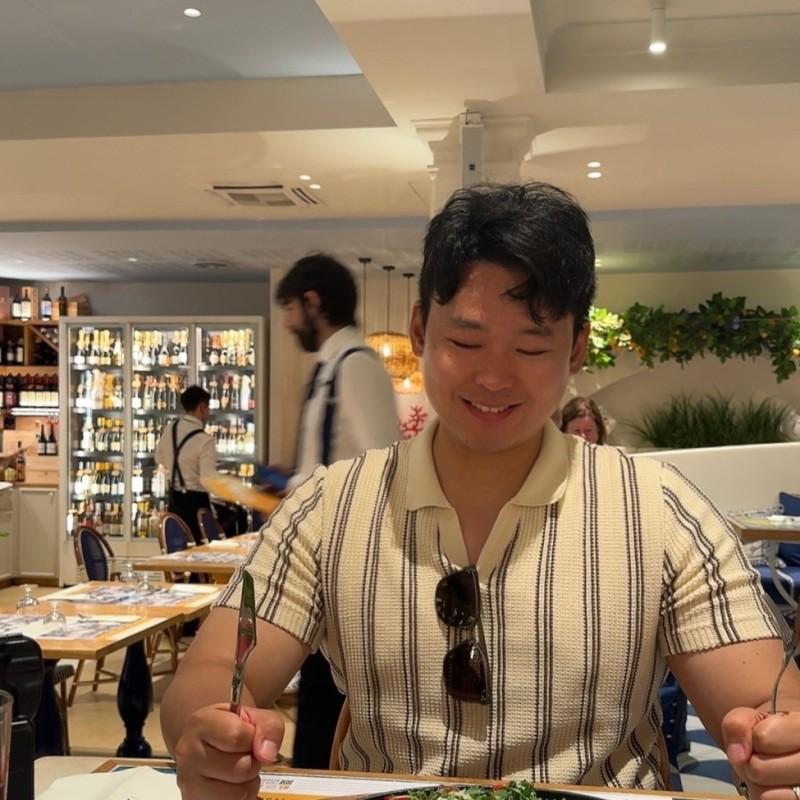
Workshop, in pictures
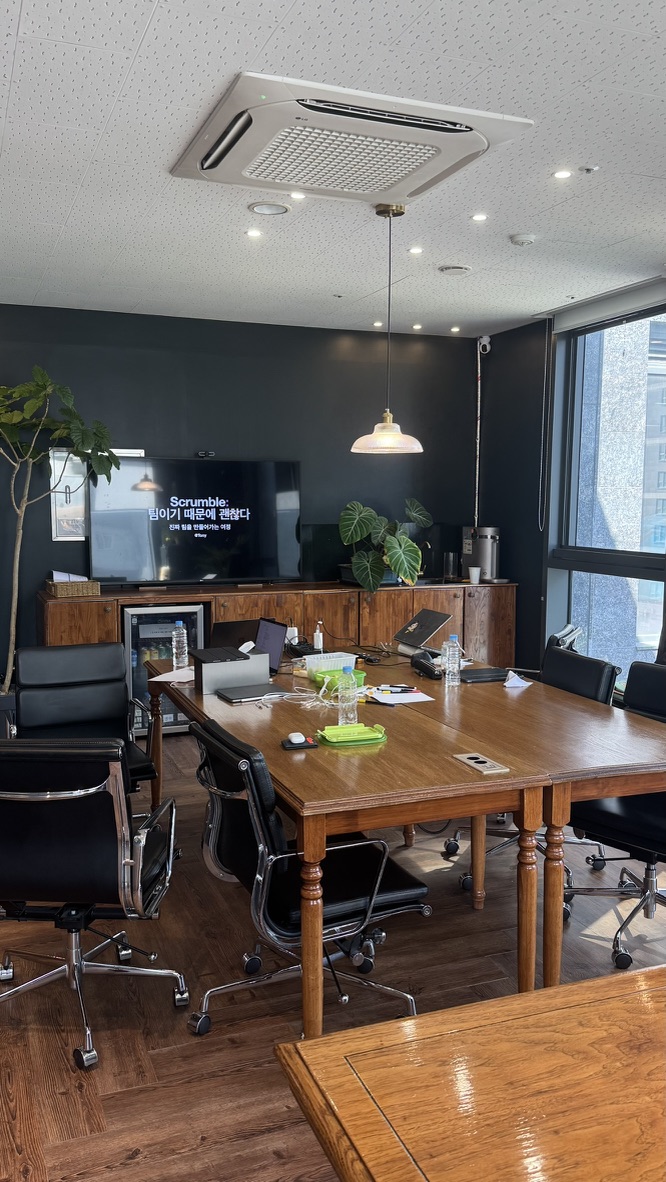
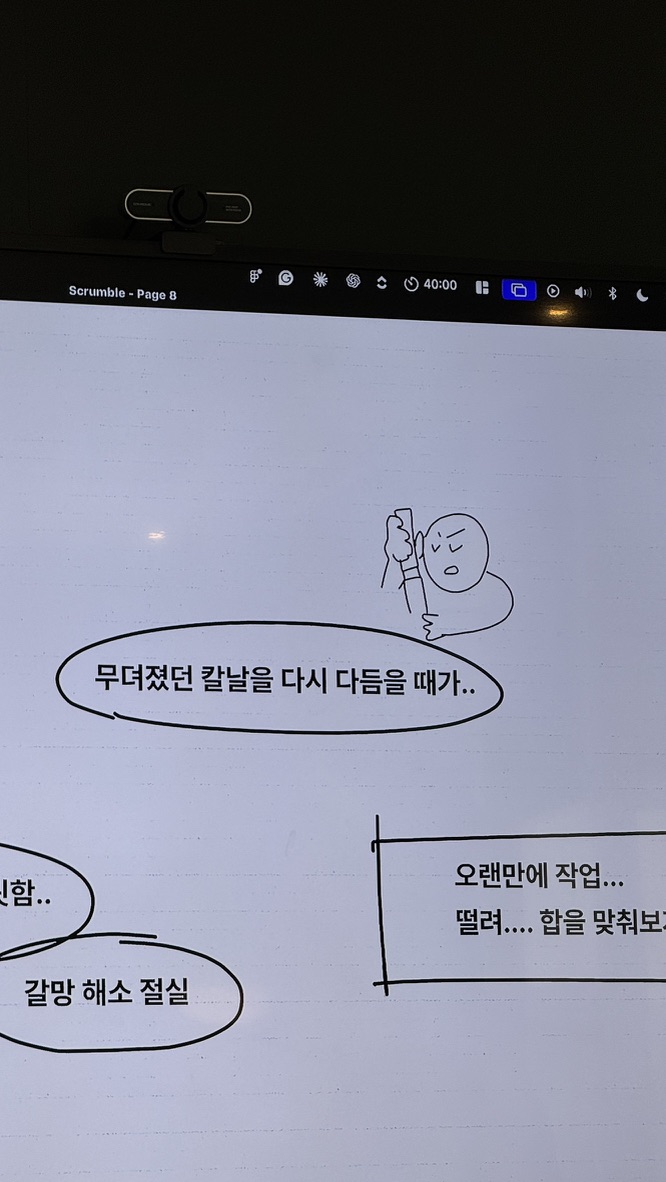
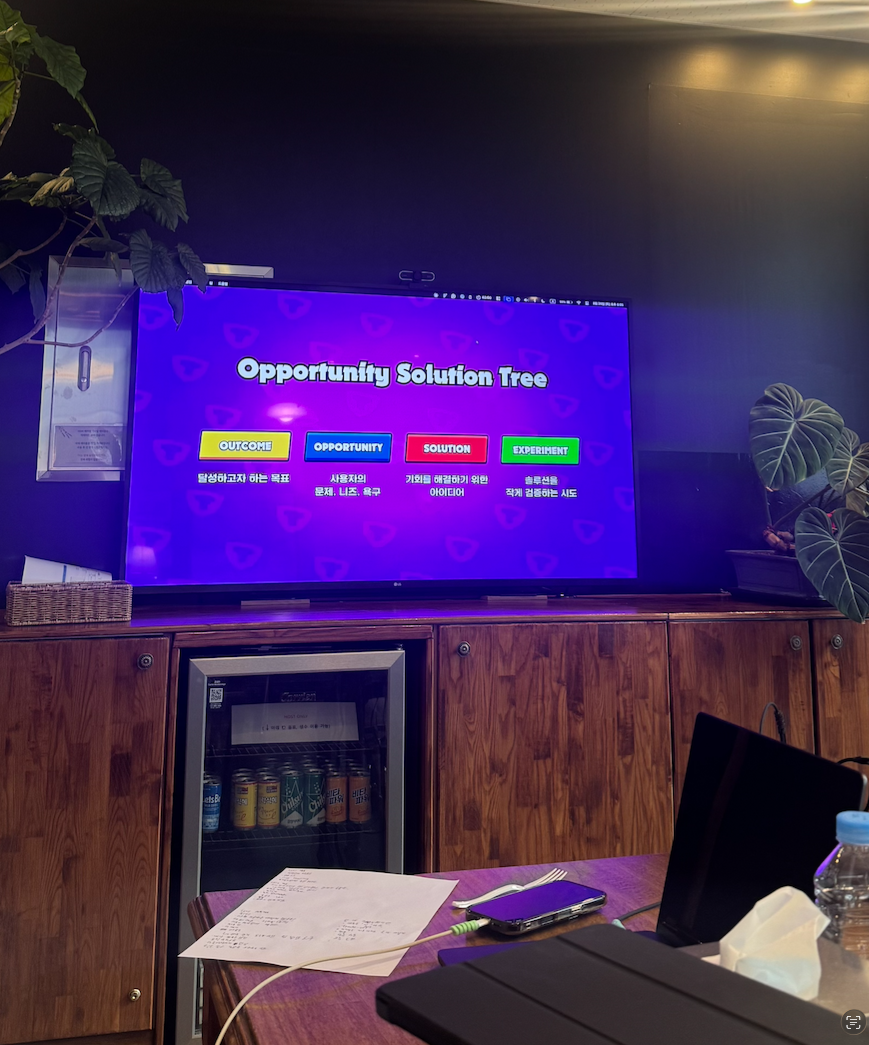
A great workshop. Let’s do it again!
The Scrumble team’s first release wasn’t just the moment we finished a feature set. It was the process of matching each other’s pace and body temperature. What kind of growth curve we’ll trace next season, and whether this interview becomes the starting point for another record, is what I’m looking forward to.
댓글
댓글을 불러오는 중...
댓글 남기기
Legacy comments (Giscus)